Share


By Philip Boahen, Lead Partnership and Coordination Manager of the Agriculture and Agro-Industry Department at the African Development Bank
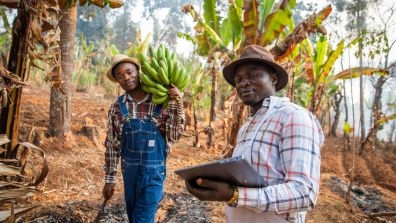
Just after dawn in Wa-Nanbongo, in Ghana’s Northern Savannah Zone, women gather at a solar-powered borehole that did not exist five years ago. Finding water used to be strenuous, especially when the 2024 dry spell scorched more than 1.4 million hectares of crops in the north, food prices spiked, and families rationed meals to survive. Today, instead of waiting for rain, farmers draw water from the earth, irrigate fields, and plant high-yield seed varieties even when the skies refuse to cooperate.
What was once a drought-stricken community is now a hub of food production powered by concessional finance, cooperative ownership, and village-level credit, thanks to the Additional Financing to the Savannah Investment Program, financed by the Global Agriculture and Food Security Program (GAFSP) through the African Development Bank (AfDB). Women and youth manage the borehole, farmers purchase climate-smart inputs using a revolving US$1 million rural banking facility, and household income grows where food aid once defined survival.
Where borrowing capacity is low, climate risk is high, and the private sector will not go without de-risking, GAFSP grants create the space for agriculture to leap forward. In a time of unprecedented increases in the number of people facing both acute and chronic forms of food insecurity and malnutrition, especially in Africa, this allows countries to reorient food systems so that policies, incentives, markets, and community power reinforce one another.
The AfDB oversees more than US$450 million in GAFSP-funded projects, reaching more than 2.3 million farmers across ten countries and thirteen operations — from Senegal to Tanzania, from The Gambia to Liberia, from Guinea-Bissau to Côte d’Ivoire — each designed to transform a system.
In Liberia, GAFSP has been the single most consistent source of agricultural investment over the past decade. The Smallholder Agricultural Productivity Enhancement and Commercialization Project, financed with US$46.5 million in GAFSP resources, expanded inland rice valleys, feeder roads, climate-smart seed, and farmer-producer linkages. It was followed by the US$9.08 million Smallholder Agriculture Development for Food and Nutrition Security Project and then an additional US$10 million allocation, all supervised by the AfDB. These grants filled the space left by limited African Development Fund envelopes and helped the government sustain food production, scale nutrition programs, and operationalize farmer field schools managed by the UN Food and Agriculture Organization (FAO), while the World Food Programme built home-grown school feeding systems that now purchase from local producers instead of importing grain.
GAFSP works where market forces alone will not. In Tanzania’s Morogoro region, where mountain terrain isolates farmers from public services, the national farmer organization MVIWATA used US$2.85 million in GAFSP support to deliver climate adaptation, extension, and market access to villages that no state-funded program could reach. The model now connects to AfDB’s Tanzania Initiative for Preventing Aflatoxin Contamination, an investment in drying facilities, storage, testing laboratories, and food-safety systems that reduce toxin-related post-harvest losses in maize, rice, and groundnuts while unlocking regional and export markets. Infrastructure here is not simply concrete and steel — it is dignity, safety, and income protected from invisible poison. It is also a model for how catalytic grant financing can trigger long-term investment by development banks and commercial actors.

The AfDB–GAFSP partnership matters because together we unblock the kind of financing agriculture rarely receives in low-income countries. Many governments will borrow for highways, power grids, or ports, but hesitate to take on debt for crop diversification, women-led cooperatives, or climate-risk irrigation. GAFSP fills this gap with grants that de-risk agriculture so that sovereign lending, private investment, and structured food markets can follow. These funds reach the people who loan financing often cannot: remote farmers, land-poor women, unemployed youth, and communities excluded from formal financial systems.
GAFSP is not only compatible with AfDB flagship programs, but it also amplifies them. The AfDB Agro-Inputs Risk-Sharing Facility and Business Investment Financing Track unlocks capital for agri-businesses that connect smallholders and consumer markets. What begins with grants can evolve into risk-mitigated lending, blended finance, and enterprise growth. That is the difference between a pilot and a pipeline, between a harvest and a system.
From GAFSP’s perspective, the partnership with AfDB is equally transformative. It enables resources to reach remote communities where needs are highest — including fragile and conflict-affected areas where AfDB’s delivery networks and field presence are essential for achieving real impact. Through these regional systems, GAFSP-backed investments have supported more than 2.1 million farmers across the globe — expanding access to irrigation, inputs, climate-smart technologies, and reliable markets, with 60% of total GAFSP grant funding reaching countries affected by fragility and conflict.
And as the World Bank Group’s recently launched AgriConnect initiative calls for deeper global partnerships — with AfDB, the International Fund for Agricultural Development, the InterAmerican Development Bank, and others — GAFSP offers a proven platform showing how multilateral development banks and development partners can work together to defragment support and deliver results at scale.
Africa is not short of farmers. It is short of irrigation, storage, seed quality, financial access, youth opportunity, food safety systems, and predictable markets. It is short of catalytic finance that says: we believe in your capacity, we will de-risk your first step, and we will help you build the institutions that last long after this grant disappears. That is why the AfDB–GAFSP partnership matters, because it is investing in capacity, reducing hunger and expanding agency.
The world is searching for scalable models to fund food systems transformation. Africa already has one. It begins at a solar borehole in Wa-Nanbongo, or in the rows of rice in Gbarnga, or in the drying sheds of Morogoro, or in the school kitchens of Jahaur.
The future of African agriculture is not a promise. It is already under construction — one concessional dollar, one climate-smart investment, one organized farmer, one strengthened institution at a time. And the work has only begun.

Type
News