Share


As we enter the new year, we at GAFSP celebrate the millions of smallholder farmers around the world working to strengthen food security, nutrition and rural livelihoods.
We recognize the dedication, innovation, and resilience of farmers everywhere and the partnerships within GAFSP that support them.
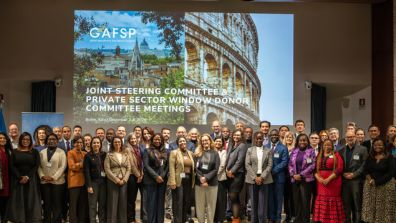
In the wake of our successful Steering Committee Meeting in Rome, the Coordination Unit and Leadership team are excited to plunge into our ambitious and pressing agenda for 2026.
In 2026, GAFSP will…
1. Put Vision 2030 into action
Vision 2030 is a bold aspiration to support transformative solutions at a critical juncture for global food and nutrition security. Up to 720 million people faced hunger in 2024, while conflict, constrained public resources, and multiple shocks continue to disrupt food production, access, and affordability globally. GAFSP’s renewed commitment reacts to the urgency of these challenges and the need for a coordinated global response. With its recently approved Vision 2030 Strategic Plan, GAFSP will:
- Incentivize — channeling support towards innovative and integrated agrifood system transformation solutions that maximize co-benefits.
- Connect — promoting multi-sector partnerships that empower smallholder men and women.
- De-risk — building confidence for larger scale public and private investments in agri-food value chains.
Our ability to bring the operational strategy for Vision 2030 over the line with a clear plan ahead, including for the first country-led Call for Proposals in a while, is a really positive achievement. 2025 had been quite a challenging year and so, against a landscape with a precipitous drop in ODA and associated impacts for food and nutrition security in many of GAFSP’s target countries, it feels important and timely to be able to respond. Here’s to 2026!
— Natasha Hayward, Program Manager, GAFSP
2. Deliver increased support for smallholder farmers and Producer Organizations
GAFSP is increasing direct financing to smallholder farmers and the organizations that represent them, helping them access technology, training, finance, jobs, value chains, and markets. This support helps improve productivity, incomes, and food availability at the community level for farmers who produce much of the world’s food in low-income countries.
The GAFSP Eighth Call for Proposals targeting Producer Organization-led initiatives, which will be allocated in 2026, is another win for smallholder farmers. GAFSP’s PO-led track is a unique funding mechanism that enables farmers to access critical inputs, secure credit, and invest in vital infrastructure such as technology, storage, and processing facilities.
3. Mobilize blended finance so that more farmers can access it
Through a robust toolkit that includes grants and concessional finance instruments, GAFSP’s Private Sector Window and new Business Investment Financing Track (BIFT) will unlock more private capital for underserved private sector agribusinesses and rural enterprises.
4. Strengthen food security in Africa
GAFSP and the African Union (AU) will strengthen their partnership this year by aligning GAFSP’s country‑led financing window with the implementation of the AU’s Comprehensive African Agriculture Development Program (CAADP) Kampala Strategy, supporting nationally-owned priorities to raise productivity, resilience, and nutrition while advancing the AU’s Agenda 2063 goals.
5. Improve food systems in fragile and conflict-affected areas
More than 40 percent of GAFSP’s grant financing goes to countries affected by fragility, conflict, and violence—contexts where food insecurity is most severe. In 29 countries, from Haiti to Somalia, GAFSP will continue to work in countries where conflict threatens food security by disrupting production, supply chain and livelihoods in the most vulnerable communities. Farmers in rural areas testify that GAFSP helps farmers and communities restore livelihoods and rebuild food systems.
Once GAFSP launches its country-led call for proposals in 2026, this will complement the on-going PO-led call for proposals and BIFT pilots. This offers real opportunities to strengthen linkages between GAFSP’s financing tracks, incentivize co-financing arrangements, improve the quality of project proposals, and capture more knowledge specific to strengthening smallholder farmers.
— James Catto, Co-Chair emeritus, GAFSP Steering Committee
6. Support the goals of the World Bank Group’s AgriConnect
The World Bank Group’s AgriConnect initiative aims to help smallholders move from subsistence to surplus by strengthening foundations such as organizational infrastructure and skills development; revamping policies to improve market links, and mobilizing capital through expanded access to finance across the food sector
The initiative uniquely leverages the joint capacity of the International Finance Corporation, the World Bank, and the Multilateral Investment Guarantee Agency, backed by an investment pledge of $9 billion per year, and supported by partners including AfDB, IFAD, IDB, Bayer, and Google.
The synergy between GAFSP’s strategic priorities and this comprehensive approach is clear.
In addition to the foundational investments and policy reform enabled through the GAFSP country-led track and the smallholder aggregation directly supported by the ongoing PO-Led Call for Proposals, GAFSP’s Private Sector Window and Business Investment Financing Track are already helping Supervising Entities unlock catalytic capital and are mitigating risks for private investments in underserved segments of agrifood value chains.
GAFSP’s potential to link farmers to markets, digital tools, and finance aligns with AgriConnect’s goals—helping farmers move up the value chain, increase their incomes, and build resilience against climate shocks and market volatility.
These initiatives represent a determined move to coordinated, scalable investments in agricultural transformation. This is what makes the upcoming year so exhilarating—not just for GAFSP as a program, but for the millions of smallholder farmers and rural communities whose livelihoods depend on sustained, inclusive progress.
— Vally Khamisani, Program Manager, GAFSP Private Sector Window

Type
News